34AA vs 34A: What’s the Real Difference
If you’ve ever stood in a fitting room wondering why your 34A bra cups keep gaping, you’re not alone. Bra sizing can feel like a mystery, especially when you’re deciding between sizes that look almost identical on the tag. The difference between 34AA and 34A might seem tiny, but it matters more than you’d think for everyday comfort and how your clothes actually fit.
In this guide, we’ll break down exactly what separates these two sizes, help you figure out which one belongs in your drawer, and show you how to measure yourself so you stop guessing entirely.
34AA vs 34A in One Glance
Here’s the deal: 34AA and 34A share the exact same band size, both wrap around a 34-inch underbust. The difference is entirely in the cup. A 34AA is designed for a bust measurement that’s roughly 0 to 0.5 inches larger than your underbust, while a 34A fits a bust that’s about 1 inch larger than your underbust.
In practical terms, 34AA holds less breast tissue and has shallower cup projection. If your current 34A cups gap, wrinkle, or never quite fill out—even on the tightest hook—34AA might give you that smooth, comfortable fit you’re looking for. But if you experience spillage or feel compressed in 34A, you likely need a cup size larger, not smaller.
|
Feature |
34AA |
34A |
|---|---|---|
|
Band Size |
34 inches |
34 inches |
|
Cup Volume |
Smaller (~0-0.5” difference) |
Larger (~1” difference) |
|
Best For |
Very shallow bust, minimal projection |
Slightly fuller A-cup bust |
|
Common Issue |
Hard to find in stores |
Widely available |
Use this as your quick reference, then read on if you want to understand exactly why these sizes behave differently on your body.
Understanding Bra Sizing: What 34AA and 34A Actually Mean
Every bra size combines two measurements: a band number and a cup letter. The number (34) represents your ribcage circumference, while the letter (AA or A) tells you the cup size based on how much your bust extends beyond your underbust.
The “34” band typically corresponds to an underbust measurement of around 31 to 33 inches, depending on the brand. Some US sizing methods add inches to your raw measurement, while others don’t, which is why you might wear a 34 in one brand and a 32 in another.
The cup letter is where things get interesting. Cup size isn’t a fixed volume, it’s the difference between your bust at its fullest part and your snug underbust measurement:
-
34AA → 0 to 0.5 inch difference
-
34A → approximately 1 inch difference
-
34B → approximately 2 inch difference
This means a 34A does not have the same cup volume as a 30A or a 38A. The cup scales with the band, so a 30A actually holds less volume than a 34A.
Example calculation: If your underbust measures 32 inches and your bust measures 32.5 inches, that’s a 0.5-inch difference, putting you in the 34AA range if you prefer a slightly looser band, or 32AA for a snug fit.
Many women in the 34A range discover they’re actually better served by a smaller band and larger cup once they measure correctly. A 30C or 32B might fit far better than a 34A if your underbust is closer to 28-30 inches. The true cup size depends on both numbers working together.

34AA vs 34A: Fit, Shape, and Everyday Comfort
Both 34AA and 34A are designed for smaller cup volumes, but they behave quite differently once you put them on. Understanding what a correct fit looks like for each size helps you determine which one actually works for your body.
What a Correctly Fitting 34A Should Look Like
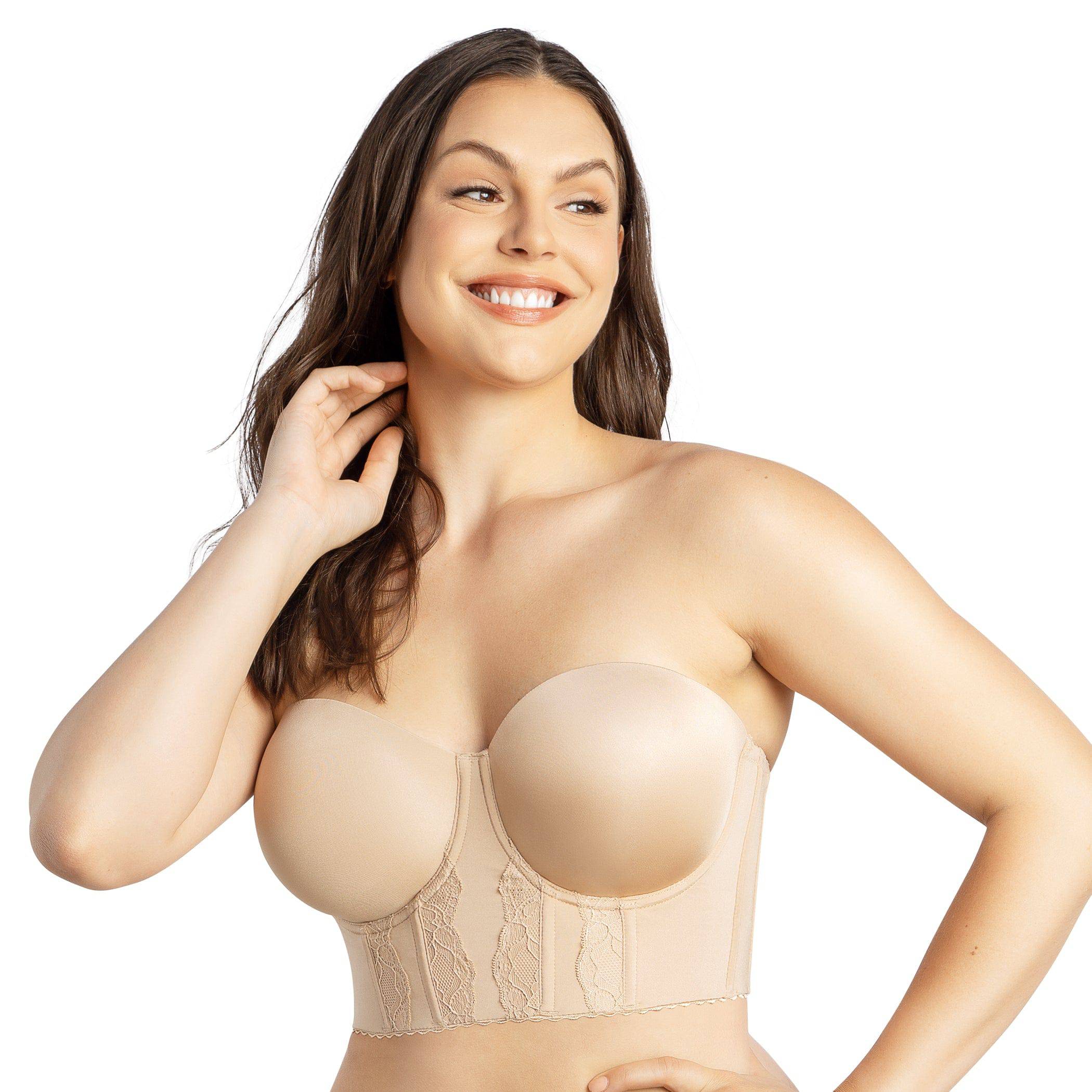
When a 34A fits properly, the cups lie flat against your chest with no spillage at the top or sides. A bit of space at the very top of the cup is normal, you shouldn’t expect skin tight suction, but there shouldn’t be visible gaping that shows through your clothes.
The band should sit level around your torso without riding up your back. If you raise your arms and the band creeps toward your shoulders, the band is likely too loose. The bra straps should stay in place on your shoulders without constant adjusting.
What a Correctly Fitting 34AA Should Look Like
A well-fitting 34AA has cups that are fully filled without wrinkles, creases, or collapse at the top or bottom. This size works especially well for people with a bust-underbust difference under 1 inch, women whose 34A cups always look slightly empty no matter the style or brand.
The fit should feel snug but not tight, with the underwire (if present) sitting behind the breast tissue rather than on top of it.
Signs Your 34A Cup Is Too Big
If you’re experiencing any of these issues, 34AA or a different band and cup combination might serve you better:
-
Visible gaping at the top of the cup, even when standing straight
-
Fabric folding or creasing inside the cup
-
Straps that you constantly tighten just to keep the cups touching your chest
-
An uncomfortable feeling of the bra “floating” away from your figure
Signs Your 34A Cup Is Too Small
On the other hand, these signs suggest you need a cup size larger, not 34AA:
-
Breast tissue spilling over the top or sides (the dreaded “quad boob”)
-
Underwire sitting on breast tissue instead of behind it
-
Cups that feel shallow, flattening, or like they’re cutting into your shape
-
Spillage that creates visible lines under fitted clothes
Take a moment to look at your current bra in a mirror. Compare what you see to these fit cues, it’ll tell you a ton about whether to size up, size down, or stick with what you have.
Sister Sizes: Why 32B and 36AA Feel Similar to 34A
Sister sizes are one of the most useful concepts in bra shopping, yet most women never hear about them. These are sizes that change the band but keep roughly the same cup volume.
For 34A, the common sister sizes are:
-
32B — tighter band, one cup letter larger, similar cup volume
-
36AA — looser band, one cup letter smaller, similar cup volume
Here’s the critical point: 34AA is NOT a sister size of 34A. It shares the same band but has a smaller cup volume. Moving from 34A to 34AA means you’re reducing how much space the cup provides.
Sister Size Equivalence Examples
|
Smaller Band |
Your Size |
Larger Band |
|---|---|---|
|
32B |
34A |
36AA |
|
32A |
34AA |
36AAA (if available) |
When might you reach for a sister size instead of jumping to 34AA?
-
Try 32B if your 34A band rides up or feels loose but the cups feel right. A tighter band with the same volume often creates better support.
-
Try 36AA if your 34AA cups feel correct but the band digs in or feels too tight around your rib cage.
Sister sizing is often more helpful than moving directly from 34A to 34AA if your main issue is the band, not the cup. Many women wearing a wrong bra size actually need a band adjustment first.
How to Measure Yourself at Home: Are You Really a 34A or 34AA?
Guessing your size based on what you’ve always worn is how most of us end up in the wrong size. Accurate measurements, not habit, are the best way to determine whether 34AA or 34A actually fits your body.
Step by Step Measuring Guide
Grab a soft tape measure and follow these steps:
1. Measure your snug underbust
-
Remove your bra or wear a non-padded one
-
Wrap the tape measure around your rib cage, directly under your breasts
-
Keep the tape snug (not tight) and exhale normally
-
Record this number in inches
2. Measure your bust at the fullest part
-
While standing straight, wrap the tape around the fullest point of your bust
-
Keep the tape parallel to the floor
-
Don’t pull tight, just let it rest naturally
-
Record this number in inches
3. Calculate the difference
-
Subtract your underbust measurement from your bust measurement
-
This difference determines your cup letter
Converting Underbust to Band Size
Most US sizing works roughly like this:
|
Underbust Measurement |
Typical Band Size |
|---|---|
|
28–29 inches |
30 |
|
30–31 inches |
32 |
|
32–33 inches |
34 |
|
34–35 inches |
36 |
Note that some brands still use the “+4 method” (adding 4 inches to your underbust), while others size more directly. Fit and comfort trump formulas every time.
Interpreting Your Bust-Band Difference
|
Difference |
Cup Range |
|---|---|
|
0–0.5 inches |
AA cup |
|
~1 inch |
A cup |
|
~2 inches |
B cup |
|
~3 inches |
C cup |
|
~4 inches |
D cup |
Worked Example
Let’s say you measure 28 inches at the underbust and 32 inches at the bust. That’s a 4-inch difference, which points to approximately a D cup. On a 30 band (the closest to your 28-inch underbust), you’d be looking at a 30D, not 34A or 34AA at all.
This is why measuring matters. Many women currently wearing 34A would get a much better fit in 30C, 30D, or 32B based on their actual measurements.
For cross-checking, use a reputable online bra size calculator (like those used by bra fit communities). Then treat 34AA or 34A as test sizes only if the calculator suggests you’re near that range.

When to Choose 34AA, 34A, or a Different Size Altogether
The “right” size depends on your measurements, your breast shapes, and how your current bras actually behave in real life. Here’s how to narrow it down.
When 34AA Makes Sense
Consider 34AA if:
-
Your underbust measurement converts to a 34 band (around 31–33 inches) with your bust at or under 34 inches, giving you less than a 1-inch difference
-
Your current 34A bras always gap or wrinkle, even in more padded or molded styles
-
You prefer a smaller, closer-fitting cup that doesn’t float away from your chest
-
You have a narrow, shallow breast shape that doesn’t fill out standard A cups
When 34A Is Likely Correct
Stick with 34A if:
-
Your underbust is around 31–33 inches and your bust is around 35 inches (about a 1–2 inch difference)
-
Your current 34A bras lie mostly flat with only slight, non-visible gaping
-
You don’t experience spillage at the top or sides
-
The band stays horizontal without riding up
When to Look Beyond 34AA and 34A
Sometimes neither size is right. Consider a totally different size if:
-
Your underbust is much smaller than 30 inches — You likely need a 28 or 30 band with larger cup letter sizes like 30C, 30D, or 28DD. The band provides 80% of a bra’s support, so wearing a too-loose band (like 34) undermines the whole point.
-
Your underbust is over 34 inches — A 36+ band with the appropriate cup adjustment will fit better. Trying to squeeze into a 34 band creates discomfort and that uncomfortable digging sensation.
-
You have side spillage or “quad boob” in 34A — This usually means you need a larger cup in a potentially smaller band (like 32C or 30D), not dropping to 34AA. Going smaller in the cup would make spillage worse.
When you shop, try on at least two band sizes and two adjacent cup volumes (for example, 32B, 32C, 34AA, and 34A) to compare directly. Minor adjustments between brands and styles are totally normal, sizes are a starting point, not a final answer.
Shopping Tips for 34AA and 34A: Styles, Brands, and Expectations
Finding smaller cup sizes used to mean hunting through limited racks, but options have expanded significantly in recent years. Here’s what to expect when you shop.
Where to Find 34AA and 34A
Most mainstream US brands routinely carry 34A, you’ll find it at department stores, chain lingerie shops, and nearly every online retailer. It’s one of the most popular A-cup variants on the market.
34AA is a different story. This size is more often stocked by:
-
Petite-focused specialty brands
-
Online retailers with extended size ranges
-
Brands like ThirdLove and True & Co that emphasize “true cup” sizing
-
UK and European brands (watch for size conversion differences)
If you can’t find 34AA locally, online shopping with free returns is your friend.
Styles That Work Well for Smaller Busts
Certain bra styles tend to complement smaller cup sizes better than others:
-
Lightly lined T-shirt bras — Create a smooth shape under clothes without adding bulk
-
Bralettes and wireless bras — Comfortable for all-day wear, especially in precise band and cup sizes
-
Removable padding options — Let you customize shape depending on the outfit or your preference
Common Fit Pitfalls to Avoid
Even within 34AA and 34A, not every style works for every body:
-
Molded cups that are too tall — These can cause gaping at the top, even if the volume is right
-
Deep plunge styles — May not sit flush against your chest if the cup is slightly too large
-
Heavily structured push-up bras — Can create an odd shape if there isn’t enough breast tissue to fill them
Make Your Shopping Trip Count
A few practical strategies:
-
Check size charts for each brand — A 34A in one brand may feel like a 32B or 34AA in another. Different brands use different construction methods.
-
Read reviews from similar shoppers — Look for people mentioning 34AA or 34A specifically, or describing measurements close to yours
-
Order multiple sizes online — If you’re unsure between 34AA and 34A, or want to try 32B as a sister size, order both and return what doesn’t work
-
Start on the loosest hook — A new bra should fit snugly on the loosest hook, giving you room to tighten as the band stretches over time

Final Thoughts
Both 34AA and 34A are valid, normal sizes that fit real women with real bodies. The AA cup isn’t “wrong” or unusual, it exists because some women genuinely need it for a perfect fit. Similarly, there’s nothing aspirational about wearing a larger cup if it doesn’t match your measurements.
What matters most is how you feel in your bra. The right size should disappear into the background of your day, no pulling, no adjusting, no uncomfortable pinching at your rib cage or shoulders.
Grab a tape measure, check your numbers, and give yourself permission to try a size you’ve never considered before. Your next bra shopping trip might finally end with something that fits.